The experts, who have adequate knowledge and clinical experience, have assessed the severity of cognitive dysfunction through daily conversation with persons with dementia and then used their assessment for treatment plans.
However, the validity of empirical practice was not shown and a survey that examined the validity was conducted in not only Japan but also in other parts of the world. CANDy was developed to assess cognitive dysfunction through conversation, even by an examiner who is a novice clinician.
“Cand” in CANDy is derived from the word candidate. The name’s meaning indicates the discovering of persons suspected to have dementia (candidates) at an early stage and in turn, the potential to lead them to appropriate treatment and support.
What is CANDy?
CANDy is a 15-item dementia screening test, assessed through daily communication with older adults. This test evaluates the occurrence rate of conversation characteristics that appear in people with dementia. The score range is from 0 to 30. The higher the score, the more severe the cognitive dysfunction. Using a cut-off score of 5/6, it has a sensitivity of 86.2% and specificity of 94.5% for Alzheimer’s disease when examiners are physicians and clinical psychologists.
CANDy has more advantages than the other neuropsychological tests. Among its advantages are the following:
〇 Both examiners and older adults feel little distress during the test as the assessment is conducted through daily communication.
Conventional examinations that screen for dementia using tests of a correct or incorrect set format can cause older adults to perceive that their own faculties are being tested. As a result, they feel distress, as observed in many cases. The feeling of distress by both examiners and older adults might cause an adverse effect on the treatment relationship. However, this problem does not occur when CANDy is used as the latter is conducted during daily communication.
〇 The effectiveness was examined based not only on an evaluation of face-to-face communication but also on an accurate impression of a typical conversation with older adults.
Although CANDy is used basically to evaluate face-to-face communication with older adults, it can also be utilized to generate impressions of an adult’s typical conversational style if the examiner is familiar with them. In our study, both methods have been shown to be useful in assess cognitive function.
〇 Learning effect does not occur because CANDy does not employ a test that indicates correct or incorrect answers.
In the case of a test, which indicates correct or incorrect answers, older adults often learn the test’s questions and their answers when it is conducted regularly; as a result, they get a high score. This phenomenon is called learning effect, which is a difficult problem arising from tests that evaluate abilities. As CANDy does not evaluate one’s abilities, such problem does not occur.
〇 The use of CANDy is expected to promote interaction between examiners and older adults and to obtain information about their lifestyle through a conversation for evaluation.
Evaluation of cognitive function using CANDy promotes interaction with older adults though open communication. Moreover, the contents of the conversation are available for free, and it is helpful to obtain this information on, among others, how older people live in their daily life and what makes their life difficult.
〇 CANDy is an objective assessment, as it evaluates the frequency of conversation characteristics expressed by people with dementia.
Evaluating the frequency of conversation characteristics is more objective compared with subjective evaluation using only observation. However, it is also important to focus on the qualitative aspects of the characteristics of the conversation to increase the accuracy of assessment. This focus is common in conventional neuropsychological tests; the test score and the information about how older adults performed the test are important in evaluating their cognitive function.
Features of CANDy
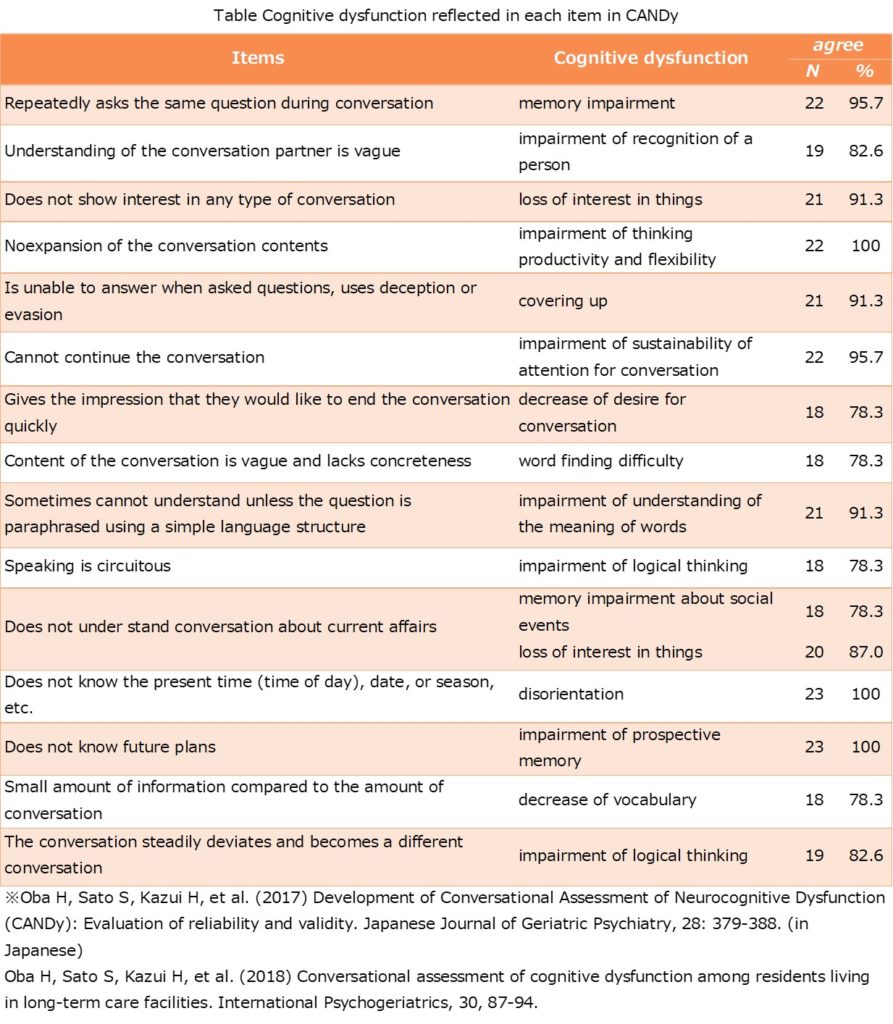
Through a survey of 23 physicians and clinical psychologists, we examined what kind of cognitive function is measured in each CANDy item. According to the result of the survey, at least 78.3% of the respondents evaluated that each item reflects a cognitive function (see Table 1).